Skip to content
JZL, Jonathan Zul Luna, home

Research

Machine learning that does the exhaustive part of an expert's work, and shows them enough to trust or overrule it.

Statement

Experts in pathology and bioprocessing make decisions from data that is huge, noisy and almost never fully labelled: a 130 GB oyster slide, or months of batch measurements from an antibody production line. My research asks how machine learning can do the exhaustive part of that work (finding, ranking, measuring) while leaving the judgement with the expert, and how to show the expert enough evidence to trust or overrule it.

My honours thesis built MSX-Sentinel, a cascade that finds a rare oyster parasite in whole-slide images and grades each oyster with fuzzy rules a pathologist can read. I also tested whether a general vision-language model could check each candidate. It couldn't do it reliably, and that is where my first research question comes from. In my MSc at UPEI, through a Mitacs Accelerate partnership with Somru BioScience, I'm developing machine learning methods for biosimilarity and comparability analysis in monoclonal antibody manufacturing.

Questions I'm working on

  • How far can structured, ontology-constrained prompting reduce hallucination when general vision-language models meet out-of-domain histology?
  • Which human-in-the-loop correction signals give the most model improvement per minute of expert time?
  • Can an interpretable model, using only the first week of batch data, predict whether a biosimilar's critical quality attributes will meet specification on batches it has never seen, more reliably than standard monitoring baselines?

Selected work

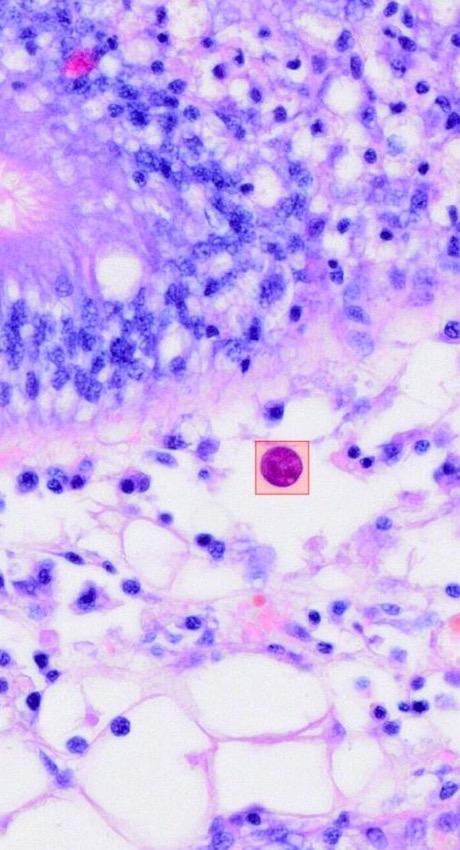
Oyster tissue, H&E stain, 40×, with one parasite candidate outlined
MSX candidate, 40×
JZL·2026·03

MSX-Sentinel

Finds MSX parasite candidates in whole-slide images and grades each oyster with rules a pathologist can read, so review starts from a short list of evidence instead of a full scan.

Agreement: κw = 0.45

Read the case study

Specimen to come: SAM candidate masks and the final segmentation for two touching oysters

JZL·2025·02

Hybrid SAM segmentation

Automatic oyster segmentation for whole-slide images: a classical tissue mask prompts SAM, then picks SAM's best answer, so each animal is isolated before any parasite search.

Manual masks: 0

Read the case study

Outputs

  • Zul Luna, J. E. (2026). An Anatomy-Informed Diagnostic Support Cascade for Proof-of-Concept Severity Assessment of Haplosporidium nelsoni in Eastern Oyster Histology. Honours thesis, University of Prince Edward Island.

    Read it

  • Zul Luna, J. E. (2026, May). AI in action: Real-world use cases in bioscience. Invited talk, PEI BioAlliance, Charlottetown, PE.

  • Zul Luna, J. E. (2025, November). How AI can be used to accelerate the diagnosis of MSX disease in PEI. Invited talk, PEI Aquaculture Alliance MSX Project Updates Workshop, Summerside, PE.

  • Zul Luna, J. E. (2025, October). Oyster MSX pipeline: A human-in-the-loop system for accelerating diagnosis. Science Atlantic Mathematics, Statistics and Computer Science Conference, Cape Breton University, Sydney, NS.

Knowledge mobilization and leadership

  • Presented MSX results to industry through the PEI Aquaculture Alliance and to diagnostic partners at AVC Diagnostic Services.
  • Co-founded the UPEI Climate Action Association in 2024 and serve as treasurer: 80+ members, events averaging 12–15 people, including dune-grass planting with Nature Conservancy Canada, tree planting with Parks Canada, 5+ cleanups and two Week Without Driving campaigns.
  • Founded AquaPathAI to put the research in the hands of diagnostic labs.

Collaborators

  • Dr. Soodabeh Asadi DezakiMSc supervisor, UPEI
  • Dr. Andrew GodboutHonours and MSc supervisor, UPEI
  • Dr. Kristina KupferschmidtHonours supervisor, UPEI
  • Dr. David GromanAVC Diagnostic Services
  • Somru BioScience Inc.Mitacs Accelerate partner

Academic CVEmail

Recognition

Research communication

  • Invited Presentation – BioNetworking Event, AI in Action: Real-World Use Cases in BiosciencePrince Edward Island BioAlliance, May 2026
  • Invited Presentation – How AI can be used to accelerate the diagnosis of MSX disease in PEIPEI Aquaculture Alliance, MSX Project Updates Workshop, Nov 2025
  • 1st Place Best Undergraduate PresentationScience Atlantic MSCS Conference, Oct 2025
  • Science Communication AwardScience Atlantic MSCS Conference, Oct 2025

Venture

  • Selected Cohort Participant – $8,000 non-dilutive funding, customer validation streamOcean Startup Project – Idea Challenge, June 2026
  • 1st Place Scalability Excellence, 2nd Place Best Financial Plan, 2nd Place Most Innovative, Pitching Funding – $7,500 total prizeUPEI Harry W. MacLauchlan Entrepreneurship Program (Panther Pitch), April 2026
  • 1st Place Idea Stream – $3,000 prizeUNB RBC Student Pitch Competition, March 2026
  • Finalist (ReactionLab)Atlantic AI Summit, May 2025

Academic

  • 3.9/4.3 cumulative GPA, BSc HonoursUPEI, 2022–2026
  • Dean's honours list, four years2022–2026
  • TD Bank Second, Third, or Fourth Year Scholarship – $2,555University of Prince Edward Island, Dec 2025